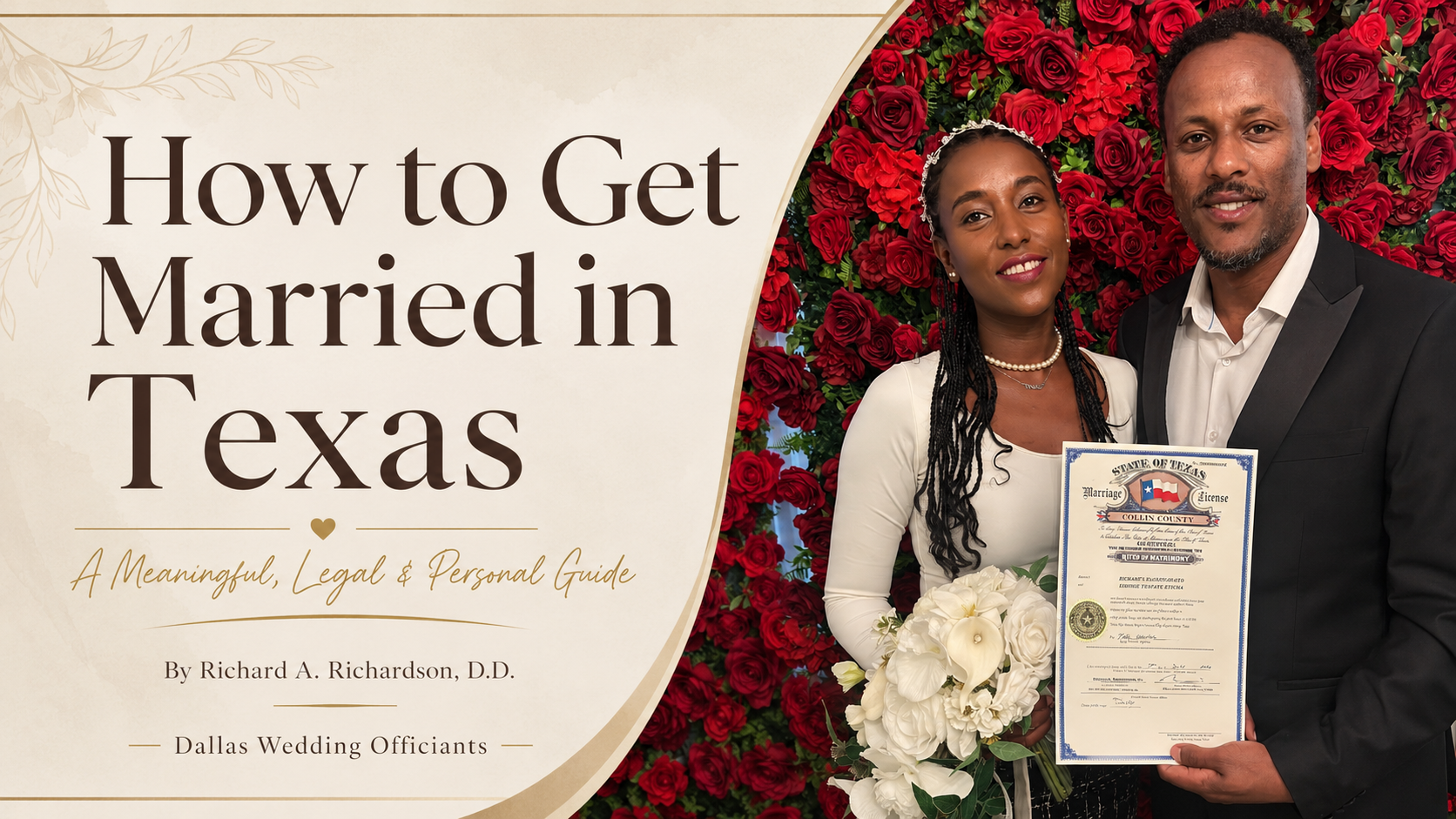
How to Get Married in Texas: Your Guide to a Meaningful, Legal, and Personal “I Do”
Getting married in Texas doesn't have to be complicated. Whether you want a simple legal ceremony, a meaningful spiritual wedding, or something personal that reflects who you are as a couple, Texas gives couples more than one path to marriage.
Marriage is one of life's most meaningful commitments. It can be a legal relationship, a public promise, a sacred bond, and for many couples, a deeply spiritual milestone.
The good news is that your wedding doesn't have to look like anyone else's.
You may want a traditional ceremony with family and friends. You may want something private with only the two of you. You may already have a Texas marriage license sitting on your kitchen counter. Or you may be looking for a spiritual ceremony followed by a Declaration of Informal Marriage.
As an experienced wedding officiant, I've had the privilege of helping hundreds of couples begin their marriages. This guide explains two different paths available to Texas couples so you can better understand your options and choose the experience that fits your relationship.
Two Paths to Consider
Already Ready to Get Married?
View Dallas Wedding Officiants ceremony options, current pricing, and available appointment times online.
View Ceremonies & Book OnlineOption 1: Get Married With a Texas Marriage License
This is the path most couples recognize.
You obtain a marriage license from a Texas county clerk, have a marriage ceremony performed by someone authorized under Texas law, and the officiant completes and returns the marriage license after the ceremony.
It's straightforward, legally recognized, and gives you tremendous flexibility in what the actual wedding ceremony looks like.
Step 1: Apply for a Texas Marriage License
Start with a Texas county clerk. Both applicants generally appear before the clerk, provide the required identification and information, and complete the marriage-license application process.
Couples who come to Dallas Wedding Officiants bring marriage licenses issued by counties throughout Texas, including Dallas, Collin, Denton, Tarrant, Rockwall, Ellis, Kaufman, and others.
Step 2: Know About the 72-Hour Waiting Period
Texas generally requires a 72-hour waiting period immediately after a marriage license is issued before the wedding ceremony can take place.
Texas law provides exceptions to the waiting period in certain circumstances, including qualifying active-duty military applicants, certain Department of Defense personnel, an approved judicial waiver, and completion of a qualifying premarital education course.
A Texas marriage license also has an expiration date. If the ceremony has not been performed before the 90th day after the license was issued, the license expires.
Step 3: Have Your Wedding Ceremony
This is the part that belongs to you.
Your legal ceremony can be intimate, traditional, religious, nonreligious, bilingual, interfaith, or personalized to reflect your relationship and values.
It may be only the two of you.
You may bring a few people who matter most.
You may exchange rings, include scripture or prayer, repeat traditional vows, share your own vows, or simply keep things short and meaningful.
At Dallas Wedding Officiants, that's where we come in. We specialize in simple, intentional ceremonies for couples who want to get married without turning the process into something larger or more complicated than they want.
Step 4: Complete and Return the Marriage License
After the ceremony, the officiant records the required ceremony information on the marriage license and signs it.
Texas law requires the person who performs the ceremony to return the completed license to the county clerk who issued it no later than the 30th day after the ceremony.
Once the county receives and records the completed document, your marriage becomes part of the county's official marriage records.
Choose your ceremony.
Bring the license.
Get married.
Already Have Your Texas Marriage License?
You may already be at the easiest part. Choose the ceremony that fits you, select an available appointment, and bring your license with you.
Check Wedding AvailabilityOption 2: A Spiritual Ceremony and Declaration of Informal Marriage
Not every couple approaches marriage through the traditional marriage-license-and-ceremony process.
Some couples want the beginning of their marriage to center first on their faith, spirituality, culture, or personal commitment to one another.
Texas also recognizes informal marriage, sometimes referred to as common-law marriage, and provides a process for couples to document that relationship through a Declaration and Registration of Informal Marriage.
Step 1: Have a Meaningful Spiritual or Religious Ceremony
A couple may choose to begin with a spiritual, religious, interfaith, or commitment-centered ceremony rather than first obtaining a traditional ceremonial marriage license.
Your ceremony can include the elements that make the commitment meaningful to you, such as:
- Prayer
- Scripture
- Blessings
- Personal vows
- Traditional vows
- Ring exchanges
- Interfaith elements
- Cultural traditions
- Spiritual reflections
Dallas Wedding Officiants can help create and perform a meaningful spiritual ceremony, and couples may receive a ceremonial certificate commemorating their commitment.
Step 2: Document the Marriage Through a Declaration of Informal Marriage
If the couple meets Texas requirements for an informal marriage, they can appear together before a Texas county clerk and execute a Declaration and Registration of Informal Marriage.
The declaration includes a sworn statement that the couple agreed to be married and, after that agreement, lived together as a married couple in Texas and represented to others that they were married.
Both parties must be at least 18 years old and legally eligible to marry one another. The county clerk also requires the information and proof of identity required by Texas law.
Once properly executed and recorded, the declaration is prima facie evidence of the marriage.
Make your commitment to one another.
Meet the requirements for an informal marriage.
Document it with the county clerk.
For couples who prefer this approach, it offers another Texas-recognized path that can allow the ceremony itself to focus on faith, spirituality, culture, or personal commitment while the legal documentation is handled through the informal-marriage process.
Why Legal Recognition Matters
However you choose to celebrate your commitment, having a legally recognized marital relationship can affect important areas of your life.
- Property and inheritance rights
- Tax filing and certain tax benefits
- Eligibility for certain health-insurance or employment benefits
- Spousal rights in medical and legal matters
- Estate and survivor rights
- Family-law rights and responsibilities
The specific legal and financial consequences depend on the couple's circumstances, but marriage is more than a ceremony. It creates a legal relationship as well.
Your Wedding Can Still Feel Like Your Wedding
Legal paperwork doesn't have to define the emotional experience of getting married.
Some couples want a traditional ceremony.
Some want five meaningful minutes.
Some want prayer, scripture, or a blessing.
Some want bilingual or culturally blended elements.
Some want to exchange rings and personal vows.
And some tell us:
“Keep it simple. We just want to get married.”
All of those couples are getting married for the same fundamental reason: they have chosen one another.
The ceremony should serve that commitment — not overshadow it.
Common Questions About Getting Married in Texas
Do We Have to Get Married at a Courthouse?
No. A courthouse or Justice of the Peace is one option, but Texas law authorizes other individuals, including qualifying ministers and religious officers, to perform marriage ceremonies.
That's why couples looking for a courthouse wedding may actually need an authorized wedding officiant rather than a courthouse appointment.
Do We Need Witnesses?
Texas does not generally require a separate wedding witness for an ordinary ceremonial marriage.
If your ideal ceremony is just you and the person you're marrying, that can be your wedding.
Do We Need Wedding Rings?
No. Rings are symbolic and are not required to create the marriage.
Bring them if you want to exchange rings. Skip them if you don't.
Do We Have to Write Our Own Vows?
No.
Dallas Wedding Officiants already has ceremony wording and vows, and we guide you through the process.
If you've written something personal, it may be incorporated into an appropriate ceremony package. If not, you don't need to create anything yourself.
Can Our Ceremony Be Religious or Nonreligious?
Yes. Depending on the ceremony selected, couples may incorporate scripture, prayer, religious traditions, secular wording, interfaith elements, bilingual elements, or other meaningful touches.
Can We Get Married With Just the Two of Us?
Absolutely.
Some couples want an intimate couple-only ceremony. Others want a few parents, children, relatives, or close friends present.
Dallas Wedding Officiants offers different ceremony options based on the experience and guest count you're looking for.
Can We Get Married on Short Notice?
If you already have a valid marriage license, have satisfied the applicable Texas waiting-period requirements, and an appointment is available, a simple wedding does not necessarily require weeks or months of planning.
Current availability can be viewed directly through our online booking page.
Want Something Simple?
You don't need a giant wedding to have a meaningful wedding. Choose the ceremony that fits you and see available appointment times online.
View Pricing & Available TimesFrom Ceremony to Celebration: Let’s Make It Official
At the heart of every marriage is a moment — your moment.
Maybe you're planning a private ceremony with just the two of you.
Maybe you're bringing your children or a few people you love.
Maybe you're planning something religious and deeply meaningful.
Maybe you simply want a dignified alternative to standing in a government building waiting for your turn.
There is no rule saying that a simple wedding has to feel insignificant.
That belief is part of the mission behind Dallas Wedding Officiants.
We want couples to have access to a meaningful wedding ceremony without feeling pressured into a larger, more complicated, or more expensive experience than they actually want.
Our nonprofit model allows us to focus on providing welcoming, dignified, accessible ceremonies while keeping the process straightforward.
That's why our ceremony options, photographs, guest allowances, pricing, and available appointment times are provided online.
You can see what we offer, choose what fits, and book when you're ready.
Ready to Begin Your Marriage?
Whether you already have your Texas marriage license or you're planning a meaningful spiritual ceremony, your wedding can be simple, personal, and centered on what matters most: the commitment you're making to one another.
Choose your ceremony. Select your appointment. Let us help you create your “I do.”
Schedule Your WeddingDallasWeddingOfficiants.com/bookonline