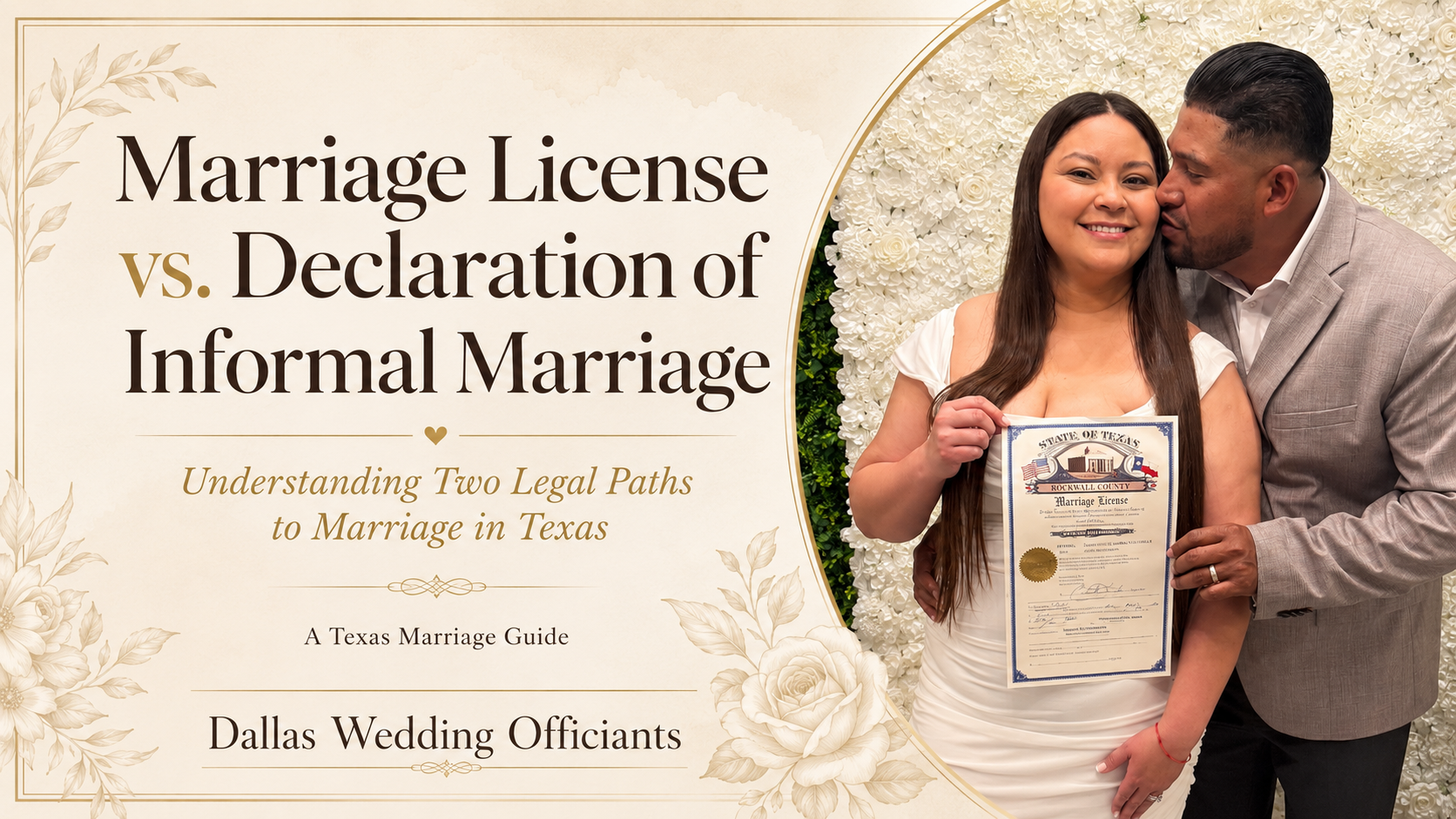
Marriage License vs. Declaration of Informal Marriage in Texas
Two legal paths to marriage in Texas — how they work, how they differ, and which option may fit your situation.
When couples think about getting married in Texas, the first thing that usually comes to mind is a marriage license: you apply for it before the ceremony, have your wedding, and the officiant completes and returns the license afterward.
But Texas also recognizes another legal path: informal marriage, sometimes called common-law marriage. Couples who meet the legal requirements can formally document that relationship through a Declaration and Registration of Informal Marriage.
Both can result in a legally recognized marriage, but they are not the same process.
The Simplest Way to Understand the Difference
License First, Ceremony Second
You obtain the marriage license before your wedding, have the marriage solemnized by an authorized officiant, and the completed license is returned to the county clerk.
Document an Existing Marriage
A Declaration of Informal Marriage formally records a marriage that the couple represents already exists under Texas informal-marriage law.
Already Have Your Texas Marriage License?
If you're ready for the ceremony, you may already be at the easy part. View Dallas Wedding Officiants ceremony options, pricing, and available appointment times online.
View Ceremonies & Book OnlineOption 1: Marriage License + Wedding Ceremony
For most couples, this is the traditional and most familiar route to marriage in Texas.
You obtain a Texas marriage license before the wedding, satisfy the applicable waiting-period requirements, have your ceremony performed by someone legally authorized to solemnize the marriage, and then the completed license is returned to the issuing county clerk.
Step 1: Apply for a Texas Marriage License
Couples apply through a Texas county clerk and provide the information and identification required by that office.
Couples who come to Dallas Wedding Officiants regularly bring marriage licenses issued by counties throughout Texas, including Dallas, Collin, Denton, Tarrant, Rockwall, Ellis, Kaufman, and others.
Step 2: Observe the 72-Hour Waiting Period
Texas generally requires couples to wait 72 hours after the marriage license is issued before the wedding ceremony can take place.
Texas law provides exceptions in certain circumstances, including some military situations, qualifying premarital education, and judicial waivers.
A Texas marriage license also expires if the ceremony has not been performed before the 90th day after the license was issued.
Step 3: Have Your Wedding Ceremony
The legal process may be straightforward, but the ceremony can still feel personal and meaningful.
Your wedding can be:
- Couple-only
- Small and intimate
- Religious
- Nonreligious
- Interfaith
- Bilingual
- Traditional
- Personalized
You can exchange rings or skip them. You can use traditional vows, personal vows, scripture, prayer, cultural elements, or simply keep things short and meaningful.
Step 4: The Officiant Completes and Returns the License
After the ceremony, the officiant completes the required information on the marriage license and signs it.
The completed license is then returned to the county clerk that issued it within the period required by Texas law.
The recorded document becomes part of the official marriage record.
Have the ceremony.
Complete the license.
Get married.
Already Have Your Marriage License? You Don't Need a Courthouse.
A lot of couples assume that having a Texas marriage license means they now need to find a judge, Justice of the Peace, or courthouse appointment.
That's not the only option.
An authorized wedding officiant can perform your legal marriage ceremony.
At Dallas Wedding Officiants, the process is intentionally simple:
- Choose your ceremony online.
- Select an available appointment.
- Bring your Texas marriage license.
- Get married.
Our ceremony options, photographs, guest allowances, pricing, and current appointment availability are published online.
Option 2: Declaration of Informal Marriage in Texas
Texas also recognizes informal marriage, commonly referred to as common-law marriage.
Texas law provides a way for couples who meet the requirements of an informal marriage to formally document that relationship through a Declaration and Registration of Informal Marriage.
The key concept is that the declaration is not used to schedule a future wedding. It documents a marriage that the couple represents already exists.
What Does an Informal Marriage Require?
Texas informal-marriage law generally looks to whether the couple:
- Agreed to be married
- Lived together in Texas as spouses after that agreement
- Represented to others that they were married
A properly executed Declaration and Registration of Informal Marriage provides formal evidence of that marital relationship.
Can We Have a Spiritual or Religious Ceremony First?
Yes.
Some couples want the beginning of their marriage to center on faith, spirituality, culture, or personal commitment rather than the traditional license-first process.
A couple may choose to have a religious, spiritual, interfaith, or personal ceremony first.
That ceremony may include:
- Prayer
- Scripture
- Blessings
- Personal vows
- Traditional vows
- Ring exchanges
- Interfaith elements
- Cultural traditions
- Spiritual reflections
If the couple also satisfies Texas's legal requirements for an informal marriage, they may later document that relationship by executing a Declaration and Registration of Informal Marriage with a county clerk.
Agree to be married.
Live together in Texas as spouses.
Represent yourselves to others as married.
Document the marriage with the county clerk.
How Does the Declaration of Informal Marriage Process Work?
Couples who meet the requirements generally complete the declaration through a Texas county clerk.
Step 1: Obtain the Declaration Form
The county clerk provides the Declaration and Registration of Informal Marriage form.
Step 2: Appear Together Before the Clerk
Both parties appear before the county clerk and provide the required identification and information.
Step 3: Make the Required Declaration
The declaration includes statements concerning the couple's agreement to be married, their cohabitation in Texas as spouses, and their representation to others that they were married.
Step 4: Sign and Record the Declaration
The parties sign the declaration before the clerk, and the clerk records the document.
Once properly executed and recorded, the declaration serves as formal evidence of the marriage.
Marriage License vs. Declaration of Informal Marriage — Key Differences
| Texas Marriage License | Declaration of Informal Marriage |
|---|---|
| Obtained before the wedding ceremony | Documents an informal marriage the couple represents already exists |
| Marriage ceremony is required | No new ceremony is required simply to file the declaration |
| Generally subject to a 72-hour waiting period | No comparable post-filing 72-hour waiting period |
| License generally expires before the 90th day if unused | Records an existing informal marital relationship |
| Authorized officiant performs the ceremony | Couple executes the declaration before the county clerk |
| Officiant completes and returns the license | County clerk records the declaration |
| Best for couples planning a wedding ceremony now | Best for couples who already meet Texas informal-marriage requirements |
Are the Two Types of Marriage Legally Different?
Texas does not treat an informal marriage as a lesser category of marriage.
Once an informal marriage legally exists, it is a marriage.
The primary distinction is how the marriage was established and documented.
A traditional ceremonial marriage begins with a marriage license and wedding ceremony.
An informal marriage is established through the legal elements applicable to informal marriage and can be formally documented through a Declaration and Registration of Informal Marriage.
A Tradition Rooted in Texas History
Why Does Texas Still Recognize Informal Marriage?
Texas has a distinctive legal history shaped by Spanish, Mexican, Republic-era, and Anglo-American legal traditions.
Historically, large distances, frontier communities, limited access to clergy and courts, and the practical realities of family life meant that not every marriage began with the formal process modern couples recognize today.
Texas law continued to recognize certain marriages based on the couple's actual marital relationship rather than solely on whether they first obtained a ceremonial marriage license.
Today's informal-marriage law preserves that distinctive Texas legal tradition while providing couples with a formal way to document their relationship.
Which Option Is Better for Us?
If you're planning to get married now and want a clear, straightforward process, the traditional marriage-license route is usually the easiest to understand:
If you already consider yourselves married and your relationship satisfies Texas's requirements for an informal marriage, a Declaration of Informal Marriage provides a way to formally document that existing marriage.
And if you want a meaningful spiritual or religious ceremony, you can still have one.
The important distinction is understanding the difference between the ceremony experience and the legal method used to establish or document the marriage.
What If We Want Something Simple and Meaningful?
Not every wedding needs a large venue, bridal party, reception, or months of planning.
Some couples want a traditional ceremony.
Some want five meaningful minutes.
Some want prayer, scripture, or a blessing.
Some want a bilingual or culturally blended ceremony.
Some want only the two of them.
And some simply say:
“Keep it simple. We just want to get married.”
That's exactly why Dallas Wedding Officiants exists.
Looking for a Courthouse Wedding Alternative?
You don't have to choose between an impersonal government-office experience and a large traditional wedding. Choose a ceremony that fits you and see current appointment availability online.
View Pricing & Available TimesA Dallas Courthouse Wedding Alternative
Dallas Wedding Officiants provides a simple middle ground for couples looking for:
- Courthouse wedding alternative in Dallas
- Justice of the Peace alternative
- Simple Texas marriage ceremony
- Couple-only wedding
- Small intimate wedding
- Religious or spiritual wedding ceremony
- Wedding officiant in Dallas-Fort Worth
Our nonprofit mission is centered on keeping meaningful wedding ceremonies accessible.
We want couples to have a dignified, welcoming wedding experience without feeling pressured into a larger, more complicated, or more expensive event than they actually want.
That's why our ceremony options, photographs, guest allowances, pricing, and available appointment times are published online.
You can see what we offer, choose what fits, and book when you're ready.
Ready to Get Married?
If you already have your Texas marriage license, you may be one appointment away from getting married.
If you're exploring a spiritual ceremony or Declaration of Informal Marriage, understanding the legal path first makes it easier to choose the ceremony experience that's right for you.
Choose your ceremony. Select your appointment. Let us help make your “I do” simple and meaningful.
Schedule Your WeddingDallasWeddingOfficiants.com/bookonline